

Welcome to the Space(x) Data Network
May 4, 2026
By Kimberly Siversen Burke
Space(X) Data Network: FY27 Budget Reveal
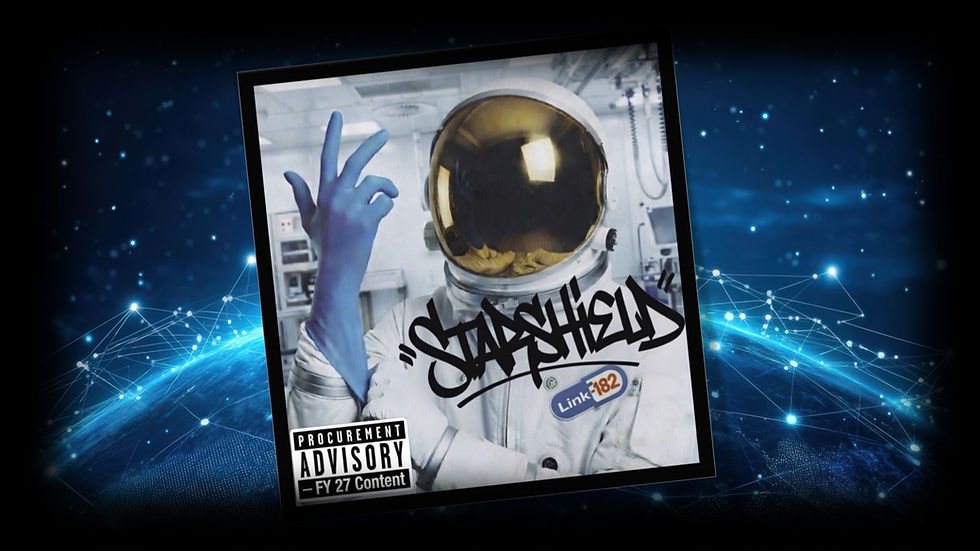
The Space Force has now officially ditched a multi-vendor SDA Tranche 3 Transport Layer procurement and funneled the dollars into a Starshield-anchored program it calls the Space Data Network (SDN) — the architecture briefly known as “MILNET.”
Total FY27 commitment for the SDN approaches $4.1B, distributed across at least five different J(ustification)-Book lines spanning Procurement and RDT&E, with no single program of record carrying the load.
One P-40 — DoW’s line-item procurement justification — dispenses with the usual euphemisms and names “Starshield” outright in the unclassified record. The remaining lines continue to lean on “partnered agency” and “commercial pLEO.” But the seal is broken.
The dollars are real. Tracking them means working from topline tables down through program elements to the project level, reconciling discretionary and mandatory funding, and noting where the public narrative runs thin. Two of the five SDN lines offer no program-level visibility: the funding appears in topline tables, and the trail ends there.
Five lines, one architecture
PE 1203636SF — Space Data Network (RDT&E, mandatory): $1.485B $685M to accelerate the pLEO mesh constellation and ground architecture, plus $800M for: “on-ramping additional vendors as the industry base and commercial technologies mature to meet U.S. government requirements.” There is no R-2 (Program Element) narrative. The table of contents jumps from line 61 to 63, and $1.485B vanishes into the gap. The whole sum is justified by two paragraphs in the Mandatory Funding Justification, which does drop one useful breadcrumb: the program "was initiated in FY 2026 within the Golden Dome for America account." Translation: this work previously sat inside last year's $4.13B classified Golden Dome RDT&E pot (PE 99999999, INDOPACOM Capabilities bin). FY27 carves it out into a freestanding "Space Superiority" line — same money, new label, named PE, no R-2 narrative. The named PE and topline are public; the program-level explanation still isn't. And because the entire $1.485B is mandatory rather than discretionary, it's contingent on a reconciliation bill that doesn't yet exist. If FY27 reconciliation stalls, SDN-Backbone RDT&E gets zero.
PE 1203601SF — MILSATCOM Terminals (SDN GEPs sub-line) (procurement, discretionary): $25.3M Funds procurement, installation, and activation of up to four pLEO ground sites. This is the mic drop. The P-40 names Starshield six times in five sentences — providing “proliferated LEO capabilities to DoW and IC users using the Starshield constellation,” fielding “Starshield ground entry terminals” for “high bandwidth mil-Ka backhaul of Starshield data.” Ten of 18 planned terminals are explicitly “for Starshield.” And “Starlink” appears once for routing data via six OCONUS ground bounce sites “into the Starshield and Starlink constellations.” It’s the only line in the entire procurement book that mentions Starshield and Starlink.
The four FY27 terminals run $2.245M each, accounting for about $9M of the $25.3M total. Site preparation and installation adds another $8.4M, hardware modifications $4.1M, and outside technical support contractors $3.8M. Cumulative FY25–FY27 spend is $66.5M, the smallest of the SDN lines and the only one that calls out its operator. Possibly because naming Starshield for $25M of ground terminals is OPSEC-cheap. It’s a terminal buy, not satellites or kill-chain capability. Plus, the build itself likely goes sole-source to SpaceX anyway.
AUX000 — Auxiliary Payloads (procurement, discretionary): $241M FY27 | $2.4B FY25–FY31 Buys 34 satellites across FY26–FY27 (13 + 21) against a 114-spacecraft initial-quantity target. Out-year unit counts are suppressed. The P-1 shows funding through FY31 but omits quantities, a sign that production rates are classified. The payload set is S-band comms relay supporting GMTI target custody and kill-chain execution. The P-40 explicitly cites the USSF’s space-based GMTI mission, then goes coy on the operator, calling it “an existing relationship with the partnered agencies.” A 100+ spacecraft S-band buy tied to a kill-chain mission and an “existing relationship” doesn’t exactly open the floodgates of competition. And the mission framing is even more Starshield-coded: enable the Space Force to “rapidly move target data around the globe and execute long range kill chains.”
PLEO00 — Proliferated Low Earth Orbit SATCOM (procurement, mandatory): $1.56B No P-40. The dollars surface only in the P-1 Detail and the Mandatory Breakout, where the reconciliation bin gets tagged "Space Superiority" before the Executive Summary folds them into a $2.38B "Space Data Network Backbone" roll-up. That's the entire public footprint for $1.5B in procurement — a classified holding bucket whose only acknowledgment is a line item and a topline.
NSSL00 — National Security Space Launch (procurement, mandatory): $819M Funds nine launches dedicated to SDN satellites, layered on top of $3.4B for 13 launches in the discretionary base for the rest of NSSL. The J-Book is unambiguous: “The mandatory request funds 9 launches of Space Data Network (SDN) satellites. The FY 2027 mandatory request continues efforts from FY 2026 to expand the number of SDN Satellites on orbit.”
Three Threads Worth Pulling
AUX000 pricing doesn’t scale cleanly. Unit economics snap in the out-years. FY26–FY27 funds 34 satellites (13 + 21) at roughly $11.5M apiece. Hold that price and the FY28–FY31 funding ($1.98B) would buy ~170 additional spacecraft, blowing past the 114-satellite initial quantity by more than 50%. To stay within that cap, out-year unit costs have to land closer to $25M.
The early units come cheap because they ride SpaceX's existing Starshield production line for the NRO. Bus, tooling, and qualification are already sunk under another customer's contract, so USSF pays near-marginal hardware cost on the first 34 vehicles. The J-Book flags those years as "non-recurring cost,” which is doing some creative accounting gymnastics. NRE typically front-loads and then tapers. Here, the curve runs in reverse: early units are discounted, and later units carry the burden. This isn’t amortization. It’s a transfer-pricing subsidy from a classified sister program. FY28+ is when USSF starts paying its own share, likely covering three things the early units don't carry:
Dedicated production capacity beyond what the existing Starshield line can absorb.
Full integration of the S-band auxiliary payload.
NRE for upgraded block variants — expanded mission capacity, hardened components, or kill-chain features that early developmental SVs almost certainly don't carry.
Two ground paths, one unapologetically commercial. The SDN GEPs sub-program discloses two terminal types. The 10 ground entry terminals pull Starshield downlinks over protected Mil-Ka backhaul — Starshield only, military spectrum. The six OCONUS ground bounce terminals push data from co-located DoW satellite ground stations up into “the Starshield and Starlink constellations” as a redundant pathway when forward sites lose terrestrial connectivity. That’s the J-Book naming commercial Starlink — not the hardened Starshield variant — as a DoW data conduit for at-risk OCONUS sites. SpaceX’s commercial constellation is now Joint Force infrastructure in degraded scenarios, on the record. This isn’t a one-off. The USCG’s August 2025 Sources Sought already required the Starshield Aero Terminal on the C-37A to be “configured to utilize both Starlink and Starshield constellations.” SDN GEPs just extend that dual-constellation model into the ground segment, where resilience matters more than ideological purity about “commercial vs. military.”
Mil-Ka is the spectrum unlock. The J-Book explicitly anchors Starshield ground-entry backhaul in protected military Ka-band — the same frequencies used by WGS. That provides priority access, interference protection, anti-jam resilience, and EMP hardening on the feeder link, where the satellite actually talks to the ground. None of that comes standard on commercial bands.
Importantly, this is link-level protection, not end-to-end network isolation. Public BGP routing data shows Starshield runs as a separate AS (AS40714) but transits upstream via commercial Starlink (AS14593) — a different routing identity but the same backbone.
The Space Force isn't pretending the network is isolated. It's betting on hardened RF where adversary EW and kinetic threats live, and accepting that once military data clears the Mil-Ka feeder, it shares infrastructure with consumer broadband. Separate at the satellite, shared at the network, legally firewalled. Musk polices that wall in public — Starshield does the gov stuff, Starlink does the consumer stuff, and never the twain shall sue.
Adding it all up
Procurement plus mandatory RDT&E adds up to roughly $4.1B in FY27 — a hair above the Mandatory Funding Overview's $3.87B "Backbone" figure once discretionary AUX000 ($241M) and SDN GEPs ($25M) get layered in. Both J-Books together show all five pieces: relay payloads (AUX000), dedicated launches (NSSL00 mandatory), Mil-Ka ground stations (SDN GEPs), a classified PLEO00 holding line, and a $1.49B RDT&E line with real multi-vendor money. Two of the five lines bury their narrative behind classification. The architecture is in full view. The operator names mostly aren't. Except in one P-40, where… surprise. They are.
Link-182: SpaceX Sets the Terms
If the spacecraft, launches, ground terminals, and spectrum tell us what the SDN runs on, Link-182 tells us how everything else plugs into it and who will collect the toll money.
On April 22, SSC awarded SpaceX a $57.3M firm-fixed-price contract to develop and demonstrate Link-182, the SpaceX-developed RF waveform operating in L/S-band that the Space Force has adopted and standardized as the protocol for user radios on the SDN.
Six days later, SSC awarded BAE Systems an $11.8M Link demo contract under the same solicitation. BAE is already a prime on Epoch 2 ($1.2B), FORGE C2 ($151M), and Golden Dome’s missile warning stack. But even with those creds, BAE is still building to SpaceX’s spec.
Per the September 2025 SSC broad agency announcement (BAA), every space-based interceptor, sensing satellite, or hosted payload that wants to ride on the SDN must carry a Link-182-capable radio. If it can’t speak Link-182, it’s shouting into the void.
That’s a classic platform play. SpaceX didn’t just win a contract — they were elected to define the language the entire neighborhood will be required to speak. The $57M demo runs through April 30, 2027 — petty cash by SpaceX standards. The real upside is the integration tax: what does every other vendor on the SDN have to buy, build, or license from SpaceX to be on the network at all?
Link-182 makes them tenants on SpaceX’s land.
The Space Force is projecting demand for thousands of Link-182-capable radios across the SDN, and a venture-backed merchant-supplier ecosystem is already forming to meet it. In the pLEO era, whoever owns the waveform owns the mission.
The T3 Transport Opus
At the April 2026 Space Symposium, acting SDA Director Gurpartap "GP" Sandhoo floated dissolving the Space Development Agency (SDA) as a standalone entity – an unceremonious fade-out for the go-fast procurement shop that once had enough swagger to coin “Foo Fighters.”
SDA, Space RCO, and SSC are being consolidated into a portfolio-based acquisition structure, replacing parallel program silos with mission-aligned Portfolio Acquisition Executives (PAEs). Sandhoo will lead the Missile Warning & Tracking portfolio, while the PWSA’s Transport Layer is migrating to the Space-Based Sensing and Targeting PAE led by Col. Ryan Frazier, who also oversees space-based MTI. Notably, transport is not heading to BMC3, where you’d expect data relay to live.
Putting Transport inside SBST recasts it from a standalone relay layer into a core element of the kill chain. Each SDN satellite already carries sensing and targeting payloads. Now transport is embedded to serve those missions directly, rather than operating as a parallel comms layer.
“Everything we’re doing on the Transport Layer at SDA should be part of that Space Data Network.” – GP Sandhoo, acting director, Space Development Agency
For anyone tracking the board, the NRO is already running space-based MTI on a Starshield-backed pLEO constellation, with another ~$7B in FY27 mandatory funding for AMTI under the same model. The SDN is being constructed on a foundation poured by SpaceX. And the same PAE will soon oversee both sensing and transport. SpaceX owns the four architectural layers underneath — spacecraft, ground, spectrum, and now waveform (bonus: launch).
The Hill has already noticed. Sen. Chris Coons has been clocking SpaceX-dependence since June 2025, when he told the SAC-D hearing that MILNET had “no competition, no open architecture, no leveraging of a dynamic space ecosystem.”
After several flags were thrown on the MILNET play, the Senate eventually revived T3TL funding last year with $500M in the FY26 budget. And now that the radioactive name that once screamed sole-source was rebranded to an easier-to-digest “Network” (read: more than one player), the Pentagon can maintain that T3 survives, just in SpaceX-shaped form, with Starshield carrying the early operational load.
The $800M SDN Multi-Vendor line looks like a future on-ramp for additional primes. The catch is that it funds development, not production. So, until there’s a clear procurement pathway into the operational constellation, non-SpaceX players are still stuck on the sidelines learning to speak fluent Link-182 to get in the game.
###
This piece was adapted from the April 2026 Megaconstellation Monthly published May 1.
Primary sources:
All Budget materials:https://comptroller.war.gov/Budget-Materials/
FY27 Procurement, Space Force Justification Book (3022F): https://www.saffm.hq.af.mil/LinkClick.aspx?fileticket=OP9M8EXQUwc%3d&portalid=84
FY27 RDT&E, Space Force Justification Book (3620F): https://www.saffm.hq.af.mil/LinkClick.aspx?fileticket=zk3U2RiIun0%3d&portalid=84
FY27 Defense Budget Request Overview Book: https://comptroller.war.gov/Portals/45/Documents/defbudget/FY2027/FY2027_Budget_Request_Overview_Book.pdf
DAF FY27 President’s Budget — full materials index: https://www.saffm.hq.af.mil/FM-Resources/Budget/Air-Force-Presidents-Budget-FY27/

