

Amazon Leo Enters the 70-Day Stretch
Updated: Jun 1
May 21, 2026
By Kimberly Siversen Burke
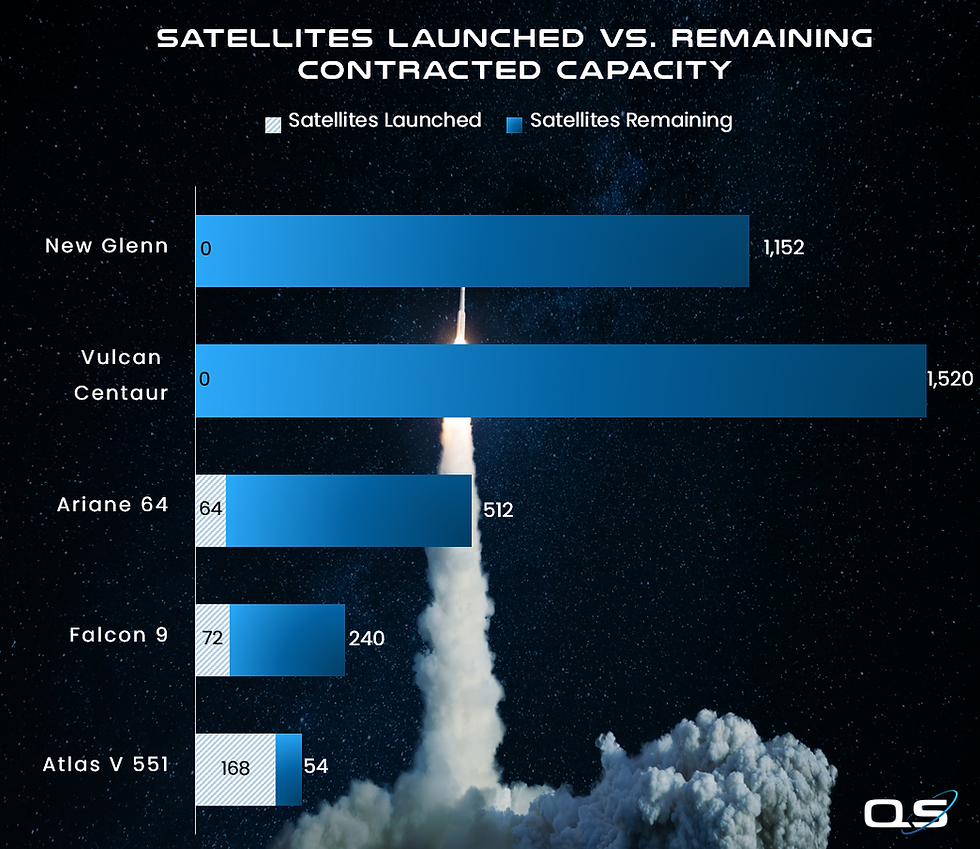
Amazon's Leo constellation is entering its 70-day stretch. To hit its July 30 FCC interim deployment milestone, Amazon needs to launch an additional 1,314 satellites. After the April 30 LE-02 mission, the Leo constellation now stands at 304 on-orbit assets – well short of the 1,618-satellite benchmark (50% of its licensed first-gen fleet) mandated by its original 2020 authorization.
Facing an impossible timeline, Amazon filed for a 2-year extension on January 30 (SAT-MOD-20260129-00065), and a Bureau-level decision is due any day. While the FCC can technically flex 47 CFR § 25.165 to trigger partial bond forfeiture or a license modification, the probability of the Commission pulling the plug on a heavily capitalized project with clear public interest benefits is effectively zero.
The FCC's milestone rules exist to deter spectrum squatters, but Amazon's issue isn't a lack of intent or investment. With a production line cranking out 30 satellites a week, dedicated processing facilities and launch infrastructure at the Cape, more than 300 satellites on orbit, three distinct user terminal designs, a 1 Gbps aviation antenna, custom ASICs, and the recently licensed Amazon Leo modem module (ALMM), no regulator could accuse Amazon of warehousing spectrum.
Layer on a growing enterprise segment with maritime deals inked, market access secured across nearly every continent, two major IFC wins (JetBlue in September 2025 and Delta in March 2026), plus an $11.57B acquisition of Globalstar, and the debate shifts entirely from whether Amazon intends to deploy the system to whether the global launch market can physically keep pace with it.
Amazon isn't stalling. It's being held hostage by a systemic launch crisis that has the entire space sector in its crosshairs.
Manifest Destiny vs. Reality: The Deficit by the Numbers

Even under a hyper-optimistic scenario — running through the entire current manifest, squeezing in four unannounced Falcon 9 flights, and factoring in a swift Vulcan return-to-flight (RTF) before July 30 — Amazon would still top out at 562 satellites. That leaves a 1,056-satellite shortfall relative to the FCC milestone requirement. It also lands a smidge under Amazon's own 700-satellite waiver projection, which was given before two of its primary launch vehicles were sidelined.
Amazon already acknowledged in its filing that the July 2026 milestone is not happening. Even extrapolating from the company’s peak launch stretch in April – a three-launch, 26-day sprint spanning LA-05, LA-06, and LE-02 that deployed 90 satellites – only adds another ~240 spacecraft by July.
And even though Amazon's Kirkland facility is churning out enough satellites to stack 200+ in the queue, the company has 3,478 contracted launch slots waiting to be filled. The math crashes out at the launchpad.
The Heavy-Lift Bottleneck
Amazon's April 2022 block-buy procurement was a bet on the next-gen, heavy-lift muscle. Vulcan and New Glenn alone are booked to carry 2,672 satellites — 77% of Amazon's unlaunched backlog. Today, both vehicles are grounded:
Vulcan (ULA): Sidelined since the February 2026 USSF-87 anomaly. A May 14 SRB qualification test confirmation offers hope, but the RTF date is still TBD.
New Glenn (Blue Origin): Grounded following an April 2026 BE-3U upper-stage anomaly during the BlueBird 7 mission, with the FAA investigation ongoing.
Meanwhile, Amazon’s hedge options are moving at a crawl. Falcon 9 hasn’t flown an Amazon Leo mission since October 13, 2025 (KF-03), and Ariane 6 is pacing at a deliberate six- to eight-week launch cadence.
The Deployment Math
Even if Amazon maxed out every remaining legacy launch contract by running Falcon 9, Ariane 6, and Atlas V to absolute capacity, the constellation would cap out at 1,110 satellites. That still leaves Amazon 508 satellites shy of the FCC benchmark.
Amazon’s economic and deployment model was never meant to ride exclusively on legacy workhorses. The constellation was built on the assumption that Vulcan and New Glenn would mature into high-cadence heavy-lift systems capable of industrial-scale deployment. Until both providers clear their respective anomalies and ramp toward a launch tempo not yet demonstrated, an FCC waiver won’t fix an industry-wide chokepoint. It just gives Amazon a longer fuse.


