China Caught a Booster: The U.S. Caught a Warning
July 10, 2026
By Kimberly Siversen Burke

America’s uncontested reign in orbital booster recovery ended on Friday.
China’s Long March 10B rocket didn’t just survive its maiden flight — its booster flew itself back into the arresting net of a recovery ship waiting downrange. Nailing an entirely novel capture method on a debut launch is a massive technical flex (not even SpaceX has done it), and the booster is already slated for re-flight later this year.
About the same time China was rolling its closest-yet Falcon 9 analog out to the pad in Hainan, the third review in six weeks flagging America's launch chokepoints landed in D.C. The audits collectively expose a congested, cash-starved spaceport network tangled in regulation and running on the fumes of Apollo-era infrastructure.
So while the U.S. has documented its physical and administrative launch problems in exhaustive, heavily footnoted detail, China just pushed up the deadline to solve them.
Three Reality Checks in a Row
A 69-page study commissioned by the Commercial Space Federation warns the U.S. is already on track to outrun its licensed launch capacity. Assuming satellites fly at their FCC-filed masses, four of the five rocket classes the researchers modeled will surpass the FAA's annual launch ceiling. And that's before accounting for proposed orbital data centers, which would drive demand past 7,000 launches per year.
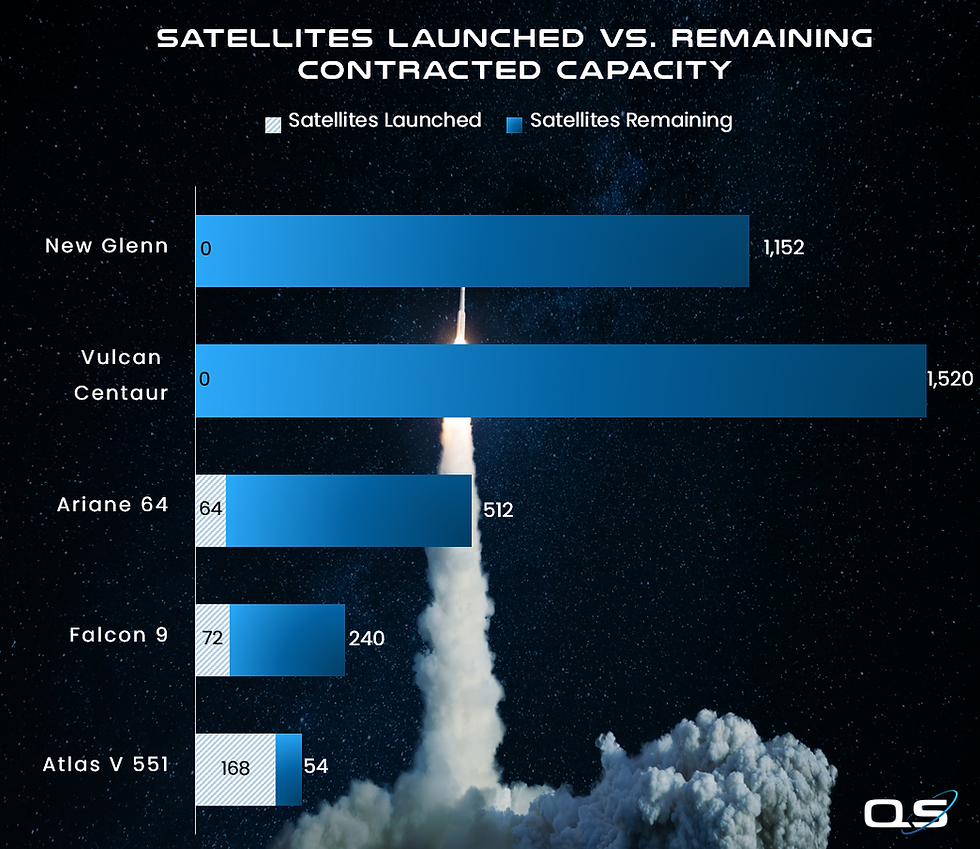
A July 2 GAO assessment exposes other issues – like how the Space Force plans to buy ~85 National Security Space Launch (NSSL) Phase 3 missions – up from about 50 in Phase 2 – but only two of the program's five (now seven) contracted launch vehicles are certified.
But it’s the NASA inspector general audit that probably best chronicles how decades of underinvestment in the Cape have led to a steady decline.
The infrastructure that supported a 252% surge in launches between 2020 and 2025 now faces another doubling in demand by 2030, even though much of it was designed when the Eastern and Western Ranges collectively supported only a few dozen orbital launches each year.
Kennedy's electrical duct banks still rely on wood-fiber and coal-tar composites, which were discontinued half a century ago. Starship's power requirements already exceed the capacity available at LC-39A, forcing SpaceX to supplement the grid with Tesla Megapacks. Two of the three transformers feeding the launch complex entered service in 1995 and have exceeded their 30-year design life. Kennedy officials told inspectors that losing either could halt launches for a month.
The strain extends far beyond the launch pads. Heavy-truck traffic has climbed 347% since 2019, and Starship alone could add another 19,000 truck trips each year across roads and bridges already operating beyond their intended lifespan.
Funding has moved in the opposite direction. NASA's infrastructure replacement cycle has stretched to 260 year – nearly four times the agency's 66-year target. Between FY21 and FY25, NASA's construction budget shrank 47% in real terms even as launch activity at the Cape more than tripled. Congress appropriated $254M. Kennedy estimates it needs a billion.
Commercial launch isn't the only casualty. Artemis depends on the same infrastructure. And the Cape's nitrogen supply cannot support two heavy-lift launch vehicles simultaneously — so an SLS campaign at Pad 39B effectively benches New Glenn at SLC-36.
There are statutory problems as well. At America's spaceports, jurisdiction changes at the fence line. Kennedy Space Center operates under NASA's funding authorities. Cross onto Cape Canaveral Space Force Station, and an entirely different legal framework takes over. The same split exists nationwide: Wallops falls under NASA, while Vandenberg answers to the Space Force. Two spaceports can confront the same infrastructure failure yet face entirely different paths to fixing it because they operate under different statutory authorities:
· On NASA property, companies cannot fund what they share. Commercial operators account for ~70% of the missions NASA supports at Kennedy and Wallops, yet the Antideficiency Act prohibits them from directly funding shared roads, utilities and electrical systems. Under appropriations law, a corporate check to repair government infrastructure is treated as an unlawful augmentation of NASA's budget.
● Next door, it's legal. Since 2013, Congress has authorized the Pentagon to accept funds, services and equipment from commercial companies for its launch infrastructure. SpaceX could legally help fund upgrades a few miles south of LC-39A at Cape Canaveral Space Force Station, or at Vandenberg — just not at LC-39A itself.
● Where rent should exist, it doesn't. NASA's 2014 agreement with SpaceX for LC-39A — the company's primary commercial pad for more than a decade — was signed under the 1984 Commercial Space Launch Act, which caps what the government can charge at direct costs. SpaceX invests inside its own fence line — a tenant is free to renovate the pad it leases — but NASA collects no fair market value for the land and legacy infrastructure underneath it, and none of that private money can legally flow to the shared systems outside the perimeter.
● Where billing is legal, it's broken. A June 2025 GAO review found the Space Force struggling to calculate what to bill commercial users at the very ranges where charging is required, even as commercial launches from federal ranges have more than quadrupled since 2021. The sums barely register anyway: the Congressional Research Service estimates the Space Force collects about $89M in direct charges and $16M in indirect reimbursements a year — while the NASA side of the fence alone needs $1B.
So why not just repeal the Antideficiency Act? Because it isn't a space law. It enforces Congress's constitutional power of the purse across the entire federal government. Gutting it would allow agencies to finance themselves with contributions from the very companies they regulate.
The statute also cuts both ways. NASA’s inspector general notes that it also bars NASA from spending appropriated funds on projects that primarily benefit commercial tenants, even when those same upgrades support Commercial Crew and Artemis.
The normal fix is a narrow carve-out, which Congress created for the Pentagon in 2013. Kennedy has spent nearly a decade trying to secure the same authority, working draft language with OMB since 2022. Sen. Ashley Moody's original Space Ready Act would create a 10-year Treasury-managed pilot fund that would allow commercial users to invest directly in Kennedy's infrastructure, but the bill applies only to Kennedy. Early drafts included Wallops before lawmakers dropped it, and the legislation has been untouched since July 2025. Moody returned with a broader proposal on July 7, 2026, called the “Space Ready 2.0 Act,” which would let NASA accept voluntary private infrastructure contributions across the agency. Like its predecessor, it now awaits its turn in the Senate Commerce Committee.
The Illusion of Capacity
The GAO's assessment makes it painfully clear how quickly these launch and spaceport constraints can hamstring national security.
The first Next Gen OPIR missile-warning satellite rolled off the factory floor in January and has been sitting in a clean room ever since. First, an overcrowded launch manifest delayed its flight. Then, its assigned rocket – ULA's Vulcan – was grounded after an SRB anomaly in February. The program has swelled to roughly $9.5B along the way, which makes that clean room some of the most expensive parking in Florida.
The workforce needed to clear the launch backlog is shrinking, too. Deferred resignations, early retirements, and a hiring freeze have thinned the certification teams responsible for qualifying new launch vehicles while overseeing dozens of NSSL Phase 2 missions through FY28. The Pentagon can award contracts to as many providers as it wants, but competition begins only after someone certifies the rocket.
The CSF “Scrubbed” study points out that pouring more concrete is not the fix. The operators interviewed identified the binding constraints as mostly operational — two propellant vendors serving the entire Cape, evacuation zones sized by explosive models that predate methane rockets, aircraft hazard areas run through black-box range models that take the FAA three to five years to certify a private alternative to, and deconfliction between billion-dollar launch campaigns handled over email, because nobody is actually in charge of scheduling.
And they have a point. The Cape has already shown how operational reforms can unlock capacity. Operators there credit a single software change — autonomous flight-safety systems replacing human range officers — with taking the site from about 20 launches a year in 2017 to nearly 100 by 2024, without building five times as many pads.
In fact, many of the pads at the Cape host no launches at all — they serve as memorials, museums, and storage, including two 1950s missile silos that hold the wreckage of the Space Shuttle Challenger. And Vandenberg keeps only four of its 20 pads active.
But dormant doesn't mean available. Except for one small-launch complex completed in 2020, none of those inactive pads can support a rocket without major reconstruction. Launch pads are bespoke infrastructure. Every vehicle demands its own propellant systems, power distribution, flame trench, sound suppression, roads, bridges, and ground support equipment.
Blue Origin drove that point home in spectacular fashion in May when a static-fire anomaly destroyed a New Glenn booster and blasted a crater through SLC-36, leaving the company without an operational launch pad despite decades of unused pads scattered across the Cape.
The U.S. doesn't have a launch pad shortage: it has an everything-else problem – the power, propellant, water and wastewater systems, roads and bridges built to support the load, and the funding and legal authority to modernize the infrastructure that converts all that concrete into launch capacity.
Even SpaceX Hits the Wall
Even the company that now launches more than 80% of the world's mass into orbit collides with the same reality. Per its S-1 filing, SpaceX’s orbital computing ambitions “will require thousands of launches per year,” – equivalent to roughly one million metric tons delivered to orbit annually.
On paper, SpaceX has approvals for 145 Starship launches a year: 25 from Starbase; 44 from LC-39A; and 76 from SLC-37. In practice, the number is 25, all from one Texas pad that can only thread an east-northeast corridor between Mexico, Cuba, and Florida, which rules out polar and sun-synchronous orbits entirely, and Mexico is already threatening to sue over falling Starship debris.
Florida's numbers remain aspirational. LC-39A's catch tower and propellant plant are still under construction. SLC-37 awaits an FAA airspace study and final Air Force approval, which would put Starship’s Cape debut no earlier than 2027. But those milestones aren't the only gating factors.
Several of Starship’s bottlenecks are municipal. SLC-37 depends entirely on the City of Cocoa's water system. LC-39A still needs state approval to withdraw roughly 297 million gallons of water annually, while SpaceX has yet to secure a discharge permit for the propellant plant's 17.7 million gallons of wastewater. Every Starship launch also creates a 12,000-foot hazard area that reaches neighboring pads used for national security missions. And on the West Coast, there is no Starship pad at Vandenberg, nor even a proposal to build one, leaving the United States without a Starship-capable route to polar orbit.
Mundane Fixes for Billion-Dollar Problems
The upside is that clearing these hurdles doesn't require bending the laws of physics.
Some of the highest-return investments are almost comically small. The Cape's shared nitrogen system — 40 miles of underground pipe that purges and inerts every pad on the property — can't support two heavy users at once, but Kennedy has already designed the fix: a supplemental plant with its own tank, pumps and vaporizers, priced at up to $25M. But the project still sits unfunded — even though it is roughly a quarter of a percent of the cost of the missile-warning satellite that has been sitting around for six months, waiting on a ride.
The operational upgrades are even less glamorous. Publish the hazard models, which today close pads on assumptions operators aren't allowed to see. Recalculate methane explosive yields — Congress already ordered this in the FY24 NDAA — so evacuation zones reflect the propellant on modern rockets rather than legacy chemistry. Stand up a single scheduling authority for a range that currently deconflicts the busiest spaceport on Earth by email.
And heed GAO's workforce warning, because adding launch providers to a contract means nothing if there aren't enough engineers left to certify their rockets. Guaranteed USG block buys create national launch workhorses. Falcon 9 was built on the back of committed government volume. And the Space Force's decision last week to add Impulse Space and Relativity Federal to NSSL Lane 1 shows the on-ramp model is still alive. But SpaceX collecting $739M in January task orders while most of the field has yet to fly also quantifies the capability gap in real time.
At a recent Citi-hosted investor event, Michael O'Donnell, the FAA's former deputy associate administrator for commercial space transportation, said “thousands” of launches per year are structurally achievable with routine investments in FAA staffing and regulatory capacity.
The question is whether Washington acts before the competitive gap narrows even further. China now operates four national spaceports plus a fifth commercial complex on Hainan. Its Haiyang sea-launch hub has completed 25 missions, carrying 155 satellites, and has recently commissioned an offshore submersible platform designed for reusable liquid rockets. As of Friday, it can add orbital booster recovery to that list.
The Catch That Changed the Equation
The Long March 10B is China's dark horse in the reusability race. Beijing unveiled the vehicle only last December, but its first stage is nearly identical to the Long March 10A, the rocket scheduled to launch China's new Mengzhou crew capsule later this year.
Strap three of those 10-series boosters together, and they become the Long March 10, the vehicle intended to land Chinese astronauts on the Moon before 2030. In 11 minutes, one successful net recovery simultaneously de-risked China's crewed lunar program and handed CALT's commercial arm a reusable Falcon 9-class launcher.
China may not wait long for a second recovery. LandSpace static-fired its second Zhuque-3 in late June and is targeting a flight after mid-July, backed by plans to produce 10 rockets and 100 engines this year. The Long March 12B already flew in June with mock landing legs during a Qianfan deployment.
That progress followed repeated failures. Long March 12A crashed its December try, and Tianlong-3 failed its April debut. But the attempts now come monthly, from a country that flew 68 orbital missions in 2024, 93 in 2025, and 47 this year by early July – spread across five land ranges and a growing fleet of sea platforms. Sticking the landing once and routinely re-flying are different sports, and China now gets to start perfecting the second one.
Nailing reusability will be key to scaling China’s “alt-Starlink” broadband megaconstellations. Qianfan (or SpaceSail) has deployed 131 satellites in 2026, including its first 20-satellite stack over the July 4 weekend, pushing the Shanghai-led constellation to 238 broadband spacecraft on orbit and past the state's Guowang for the Chinese NGSO lead. Its operator, Shanghai Spacesail Technologies, has told regulators that commercial service in China and Brazil starts in Q4 of this year.
SpaceX's advantage remains laughably enormous, with 1,589 Starlink satellites lofted in the first half of 2026 – a 14-to-1 margin over Qianfan. The U.S. still out-launches China, 104 attempts to 47 through July 9. But strip out SpaceX and the lead evaporates: the rest of the U.S. launch industry has flown just 22 missions this year against China's 47.
If these audits of America's launch infrastructure prove anything, it's that supremacy is a maintenance item, not a birthright. China could soon catch up to the U.S., just as it caught its booster Friday – cleanly, quietly, and while America was still asleep.
###