Borrowed Rockets, Built Rockets, & the Ones Amazon Won’t Buy
Nov. 20, 2026
By Kimberly Siversen Burke

ULA’s preliminary assessment of the Nov. 15 Leo 1 launch anomaly points to inadequate fuel flow from the vehicle to Vulcan’s BE-4 engines, rather than an engine defect, as the cause of the thrust shortfall. The investigation into the underlying cause is ongoing. (Credit: ULA)
Amazon Leo lost 40 satellites on Nov. 15 after ULA’s Vulcan suffered a thrust shortfall from liftoff, derailing the rocket’s first Leo mission following a nine-month stand-down. ULA’s preliminary findings released Nov. 18 point to inadequate fuel flow from the vehicle to its two Blue Origin BE-4 engines, not a failure of the engines themselves. The Northrop Grumman GEM 63XL solid boosters, whose nozzle anomalies grounded Vulcan in February, performed nominally after the nozzle improvements.
The failure marked the first total mission loss in ULA’s 20-year history, on a flight the Space Force was watching before requalifying Vulcan for national security launches. It was also the first of the 38 Vulcan launches under contract with Amazon to carry more than 1,500 Leo satellites.
Amazon’s other heavy lifter is still sidelined as well. Blue Origin’s New Glenn stranded its payload in April, then destroyed its own pad on May 28 when the main oxygen valve on a BE-4 failed during a hot-fire test. The company is rebuilding Launch Complex 36 and says New Glenn’s return to flight (RTF) is slated for January 2027. That date was after valve fixes qualified in November, so it’s possible the Vulcan anomaly investigation findings push the RTF even further to the right.
ULA, meanwhile, is living off its parents. Boeing and Lockheed Martin each guaranteed $750M of ULA borrowings in the third quarter and expect to put in more this quarter, and Lockheed, which carries its half of the venture at $578M, told investors it could take impairment and operating losses if Vulcan stays grounded.
Amazon had roughly 400 satellites on orbit before the loss, and the FCC’s June waiver of its half-constellation milestone left the July 30, 2029, full-deployment deadline in place. The company finished building its 1,000th satellite in September, so the chokepoint is still its ride.
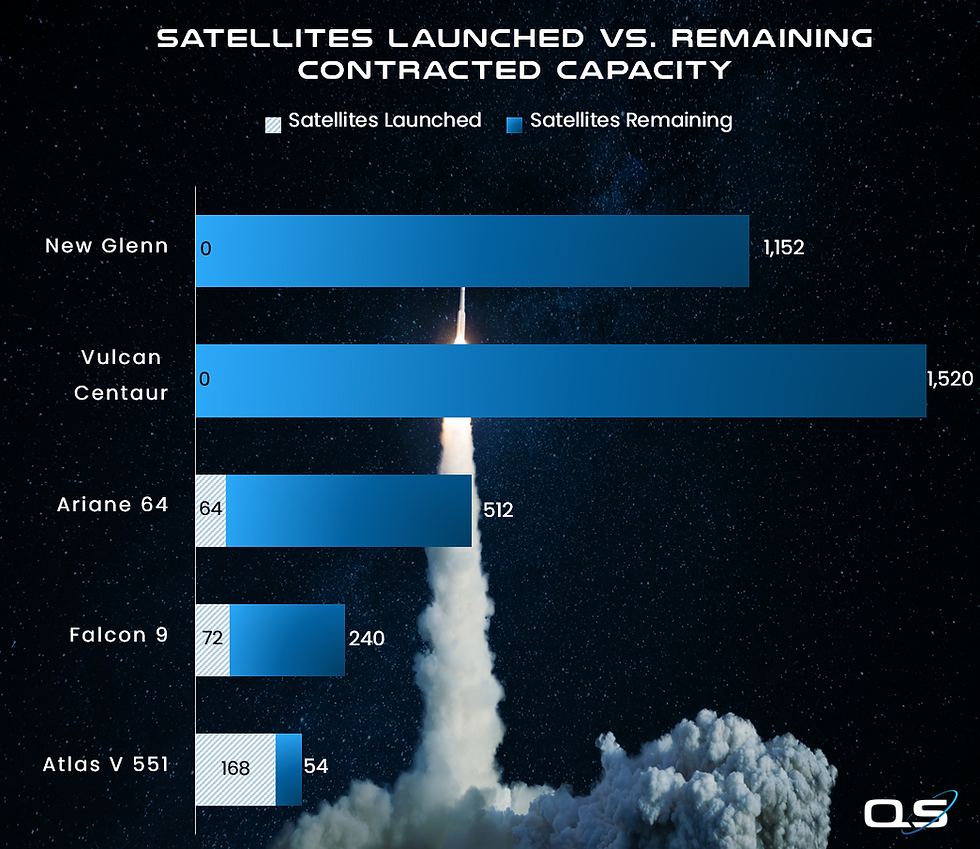
Amazon hedged against exactly this four years ago. After booking nine Atlas Vs, the company inked a $10B+ April 2022 agreement for 68 firm launches and 15 options – 83 in all – on Vulcan, New Glenn and Ariane. It’s still the largest commercial launch procurement ever signed, locked in before any of the three rockets had flown. Now two of those launch vehicles are grounded at once, and the hedge is the only reason that’s a setback rather than a shutdown. Had Amazon bet on either one alone, Leo would be parked.
Everyone is Hedging
Quilty counts 17 publicly announced multi-launch agreements so far in 2026, up from five in all of 2025. Notably, most of this year’s buyers already had a launch provider under contract when they booked the next one.
Synspective, already booked on Rocket Lab’s Electron, added 20 more Electron launches on Sept. 30 for 2028 through 2031. Six weeks later it signed Firefly Aerospace for up to 10 Alpha missions through 2030, putting as many as 30 flights across two providers in under two months.
iQPS, another Electron customer, has 18 launches booked with Rocket Lab and added MaiaSpace in September for missions starting in 2029.
Eutelsat, which finished deploying the OneWeb fleet on Falcon 9 and India’s LVM3 after losing Soyuz in 2022, signed Maiaspace in January and ordered two Ariane 64s in September for replenishment.
The rush to secure launch capacity is filling manifests years in advance. Rocket Lab ended the third quarter with a 117-mission backlog. Neutron, which has yet to fly, already has 16 missions booked, a base price that has climbed from $55M to $70M, and no open slots before the 2030s. MaiaSpace has sold more than half of Maia’s first three years of flights, also before the rocket’s debut.
So while satellite operators are booking unproven rockets years ahead because established vehicles have very little launch capacity left to sell, it’s worth remembering that Amazon has run this playbook harder than anyone. The company kept hedging after 2022. It added three Falcon 9s in December 2023, bought 10 more in late 2025 while converting all 15 New Glenn options to firm orders, and in September took its Ariane 64 order to 24 by adding six. And by funding a second vertical integration facility and mobile launch platform at SLC-41, Amazon gave ULA the ability to stack one Vulcan while another occupies the pad — which is how LV-02 was already in assembly before LV-01 left the ground.
Amazon executed a multi-provider strategy at a scale few operators can afford — splitting orders across multiple vehicles, securing firm slots years out, and funding ground infrastructure to compress turnaround times — and yet it still finds itself stuck in the same bottleneck as the rest of the space sector.
When Owning the Rocket Pays
AST SpaceMobile is taking a slightly different tack. On Nov. 6, the company announced plans to develop its own 20-ton rocket, Blacklift, powered by Firefly’s Miranda and vacuum-optimized Vira engines. The agreement, which Firefly values at more than $1.3B, commits AST to roughly $800M upfront in cash and stock for a perpetual license to manufacture both engines. AST will pay another $250M for engines on its first three rockets and $250M over three years for engineering support, build the engines at a new U.S. facility of its own, and expects operational launches in late 2028.
Blacklift is purpose-built for AST’s BlueBird satellites. A BlueBird is a flat array the size of a tennis court, and the rockets that can carry one can take at most a handful. Blacklift’s dimensions and configuration accommodate the way AST packs and deploys the spacecraft, allowing it to carry up to five per flight. Owning the vehicle would let AST fly on its own schedule and target the orbital planes its network requires. And, bonus: the booster is designed for reuse. The propulsion system brings more than a decade of development and over 175 hot-fire tests, including full-power runs at 110% of rated thrust.
Importantly, AST isn’t cutting ties with outside launch providers either. Blacklift will supplement its existing multi-provider strategy: BlueBirds 14 through 16 are awaiting a SpaceX launch date, and a Blue Origin flight is expected in early 2027 under the agreement AST signed in November 2024. The strategy gives AST two levers — buying launch capacity when the market can supply it, or flying its own rocket when controlling cadence, orbital insertion, and deployment economics makes more sense. That’s the version of ownership the launch crunch justifies.
It’s also the version Amazon cannot easily copy.
Buying ULA Solves the Wrong Problem
Launch-crunch panic attacks tend to ratchet up M&A chatter, and there's been no shortage of talk about whether Amazon can buy its way out of its bind by acquiring ULA.
I mean, Amazon was willing to plop down $11.57B to acquire Globalstar and secure a foothold in DTD, and Rocket Lab is paying an $8.1B enterprise value for Iridium. So then why not buy a launch provider? ULA has been shopped at $2B-3B, a fraction of either price.
The comparison holds up only until you start to peel back more layers.
Iridium gives Rocket Lab an operating satellite network, exclusive spectrum rights, and recurring service revenue — turning a launch and spacecraft manufacturer into a vertically integrated operator with a captive customer for its own hardware. Globalstar gives Amazon the exclusive spectrum to enter DTD. In both cases, the buyer wanted an asset the FCC had licensed to a single incumbent, making an acquisition the only way in. That’s not launch. Anyone can book a rocket without owning the company that builds it — and Amazon already buys from four. The SpaceX-Starlink model is exceptional, which is why no one has ever replicated it. And ULA is not a path there for Amazon. Owning it wouldn’t add a single Vulcan to Amazon’s manifest or find a fuel-supply fault faster than ULA’s engineers. It would just make Amazon the one covering a grounded expendable rocket’s losses instead of Boeing and Lockheed.
It would also turn a conflict Amazon has already survived once into one it couldn’t resolve. ULA’s engines come from Bezos’ other company. When Amazon’s board approved the 2022 launch contracts, Bezos recused himself while independent directors made the decision. But that didn’t stop a pension fund from suing Amazon in August 2023, alleging the board spent less than an hour on the awards, never considered Falcon 9, and directed nearly 45% of the contract value to Blue Origin, either through launch orders or its BE-4 engines. Delaware’s business court dismissed the suit in early 2025, and the state Supreme Court affirmed in November, finding that the board had followed a process and that Bezos had stayed out of it.
The relationship the court blessed has since grown as Leo’s constellation nears its service start. Amazon’s latest proxy puts payments to Blue Origin at an estimated $1.8B last year, up from roughly $578M the year before, and Bezos still owns 8.8% of Amazon.
As ULA’s owner, Amazon wouldn’t be able to firewall Bezos out of the business. Vulcan’s first stage runs on two BE-4s and ULA has not qualified a second engine supplier, so every booster engine Amazon’s launch subsidiary bought would come from Bezos’ other company — a company that also competes with ULA for every NSSL mission and every Leo batch. A director can sit out a boardroom vote, but he can’t sit out the daily operations of a launch business that buys from and bids against his own.
AST’s arrangement with Firefly avoids both conflicts. Firefly is an outside supplier controlled by AE Industrial Partners, not a company run by an AST insider, so the engine purchase is an ordinary supplier relationship. The perpetual manufacturing license also gives AST long-term independence: Firefly supplies engines for the first three rockets, but AST can manufacture subsequent engines itself. Unlike ULA, which must buy every BE-4 from Bezos’ Blue Origin, AST won’t be captive to its engine supplier.
Plus, a Bezos company already tried to buy ULA. Boeing and Lockheed put the venture up for sale in 2023, and by that December Blue Origin and Cerberus were among the bidders. By February 2024, Blue Origin had emerged as the likely buyer. Talks with Sierra Space followed that August. But nothing ever closed, and neither the sellers nor the bidders have said why.
The Space Force Can Shop Elsewhere
The other obstacle for any Bezos-owned buyer is how the Pentagon buys launch.
The Space Force deliberately splits its most demanding national security launches among three companies: its NSSL Phase 3 Lane 2 awards anticipate $5.9B for SpaceX, $5.4B for ULA, and $2.4B for Blue Origin across roughly 54 missions through FY29. The three-provider structure is insurance against one rocket failing, and it’s the same policy that let ULA exist to begin with. Back in 2006, the FTC cleared the Boeing-Lockheed tie-up because the Pentagon said a single consolidated provider served national security better than two failing ones.
On paper, the Space Force has three Lane 2 providers. In practice, it has just one. When the Space Force assigned the second year of Lane 2 missions in October 2025, SpaceX got five, ULA got two, and Blue Origin got none, because New Glenn was still working through certification. Blue Origin landed its first NSSL Lane 1 task order for the NRO on May 28 – hours before New Glenn exploded on its pad. Then Vulcan failed. Of the three Lane 2 providers, only SpaceX is currently launching. Putting ULA under Amazon wouldn’t take a rocket off the list, but it would put two of the three under one owner, which is the thing the three-provider structure was designed to prevent.
Plus, ULA’s share of NSSL launch is not locked in. The Space Force could steer task orders toward other launch operators and keep expanding the NSSL roster. It added Rocket Lab’s Neutron and Stoke’s Nova to the Lane 1 contract in FY25, then on-ramped Impulse Space and Relativity this year, bringing the pool to seven providers eligible to compete after a successful launch. Firefly is also gunning for national-security work with Eclipse, a 16,300-kg-to-LEO medium-lift rocket co-developed with Northrop Grumman that aims to debut no earlier than 2027.
An Amazon-owned ULA would also hand the Space Force a second problem on top of reliability. Amazon would need to deploy roughly 2,800 of its own satellites by July 2029 to keep its FCC license, giving it every commercial reason to prioritize Leo batches ahead of government payloads on its own rocket. The Pentagon would be trading a launch-reliability risk for a scheduling conflict with the owner.
Oh. And Not Blue Origin, Either
If Amazon ever decides it needs to own launch the way SpaceX owns Starlink’s, logic says it would be a reusable vehicle, not an expendable rocket grounded for nine months and dependent on a sole-source engine from the chairman’s other company.
And let’s not forget that Bezos already built that vehicle. But buying Blue Origin gets Amazon nothing it hasn’t already paid for and hands it problems it doesn’t have. Amazon holds 24 firm New Glenn launches, so ownership buys the same 48 satellites per flight from the same grounded rocket. It puts a founder on both sides of a transaction Delaware courts review under their strictest standard, at a company whose board has already been sued over far smaller payments between the two. It absorbs a private company’s losses with no public financials to price them. And, again, it leaves the Space Force with two Lane 2 providers instead of three.
The regulatory reasons to silo the two are even more pronounced.
Amazon’s licenses already carry a missed milestone and a waiver, and the Gen2 grant took five years to clear. Folding Blue Origin’s 5,408-satellite TeraWave constellation into that would be a major modification the FCC would treat as a new application, putting Amazon’s existing priority in play for nothing. Kept separate, TeraWave gets its own milestones and its own balance sheet. And with TeraWave’s Ka-band request sitting in nearly the same envelope as Amazon’s Gen2 since its September modification, the two networks could one day connect under a simple coordination agreement without jeopardizing either one’s regulatory position.
So, bottom line, no one is lining up to take an Amazon + Blue deal to a shareholder vote.
Buying Its Way Out of the Bottleneck
What gets Leo to 2029 is the play Amazon has already run, plus the launch luck every rocket could use right now.
Amazon has booked more launch capacity than its first constellation requires. Roughly 2,800 satellites remain to be deployed under the Gen1 license for 3,232, and the nine Atlas Vs are already flown. Its outstanding contracts cover 37 Vulcans (carrying 40-45 satellites per launch), 24 New Glenns (~48 satellites per launch), the remaining 21 Ariane 64s (32-36 satellites per launch), and 10 Falcon 9s (24 satellites per launch). If every mission flies, that’s capacity for more than 3,500 satellites.
The surplus is the payoff from Amazon’s 2022 hedge: it can absorb the loss or delay of roughly a fifth of its planned launches and still meet the July 2029 deadline. But that margin depends on keeping multiple providers in the rotation, and losing Vulcan and New Glenn for an extended period would consume that cushion pretty quickly.
And whatever capacity is left is already spoken for. The FCC authorized Amazon’s Gen2 and Polar constellations in February: 4,504 more satellites due half by 2032 and all by 2035, and Amazon’s pending DTD application requests 5,105 on top of that. At 48 per New Glenn, Gen2 and Polar alone are another 94 launches, which is why Amazon needs more rockets, not a rocket company.
Near-term, the constellation grows on the rockets that fly. Ariane 6 has delivered 100 satellites this year across three flights, with 36 more targeted for Nov. 23. Vulcan returns once ULA finds the fuel-supply fault, with LV-02 already stacked. New Glenn flies 48 at a time once the rebuilt pad is complete. SpaceX has sold Amazon 13 Falcon 9s but has launched only three so far.
Revisit Rivian?
Amazon also could revisit a supplier-financing model it has used before. In 2019, the company put $440M into Rivian and ordered 100,000 custom electric delivery vans, paying as Rivian delivered — securing a dedicated supply of built-to-spec vehicles without having to buy an automaker itself.
The same structure could work for a launch provider. Amazon could take a minority stake in a company like Relativity, whose Terran R is designed to carry 23,500 kg to LEO, or Stoke Space, whose Nova Block 2 targets 15,000 kg. It could pair that investment with a committed block of launches, releasing payments as the vehicle clears development, test, and flight milestones.
Because while money can’t bend physics, it can fund the test infrastructure, qualification campaigns, and pads needed to get a new vehicle through its paces. An investment in a company Bezos doesn’t own avoids the related-party conflict that would kneecap a Blue or ULA acquisition. Firm orders also give a provider the revenue certainty to expand production and ground infrastructure, while giving Amazon priority access. A stake doesn’t guarantee the rocket reaches orbit — Amazon would still carry technical and schedule risk — which is exactly why the model is a stake, not a purchase, and why it works best spread across more than one provider.
Amazon doesn’t need to own the rockets that get Leo to orbit. It needs to hold the line on the strategy it set in motion four years ago — buying more launch capacity than its manifest requires, keeping multiple providers in the rotation, and using that cushion to keep 40 satellites in the Atlantic a footnote rather than the whole story.
###